









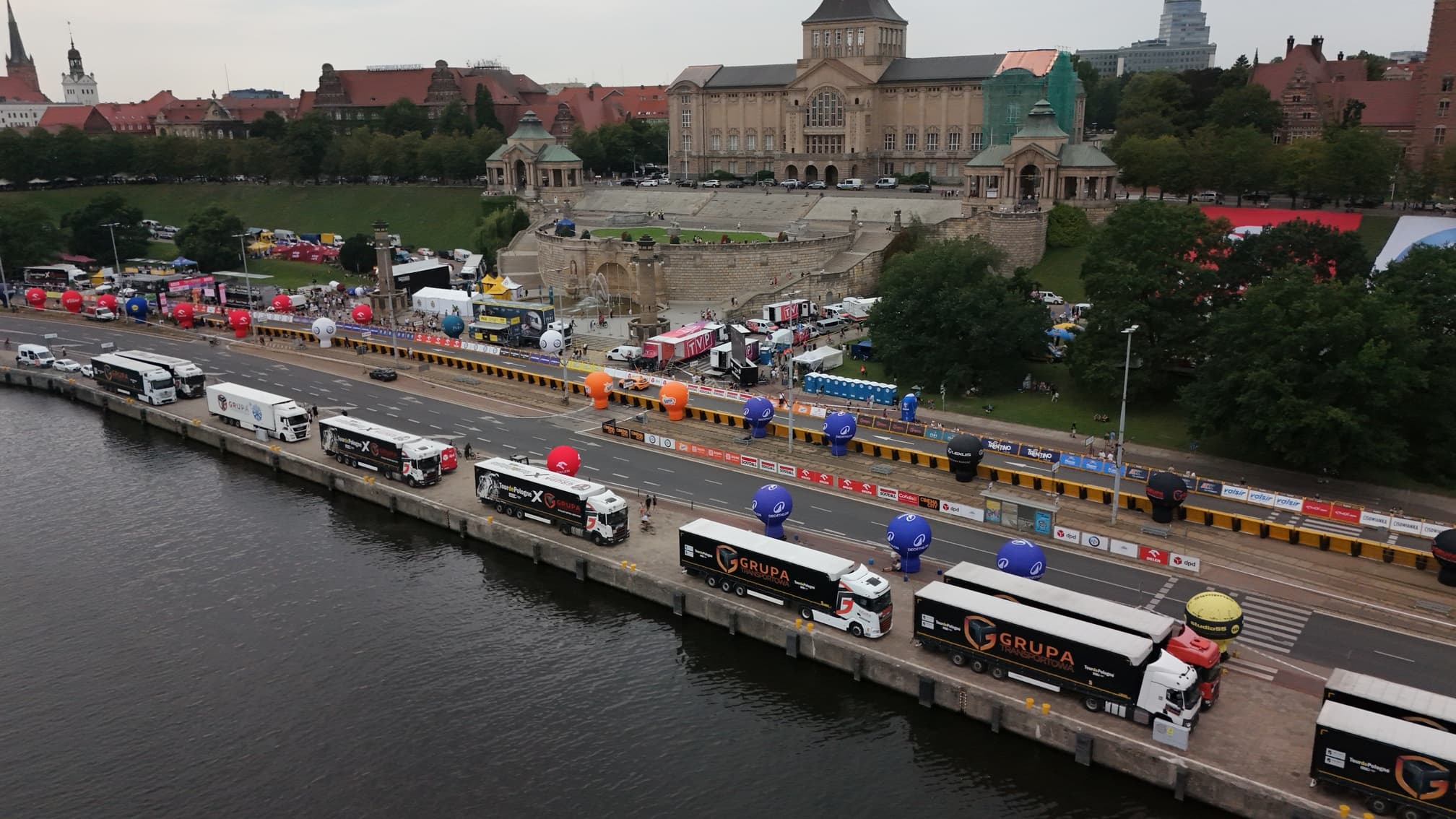
In July and August 2026, Grupa Transportowa for the second time in a row provided logistical services for the Tour de Pologne - the main edition, the Tour de Pologne Women and the ORLEN Tour de Pologne Amateurs. At its peak, 25 sets were working on the routes, which travelled over 6300 km and reached 18 stage locations, from Gdynia to Bukowina Tatrzańska. Barriers, scenography and technical facilities were in place ahead of time at every stage. Balance of operations: zero incidents, zero delays.
Logistics as fast as a peloton
The fan can see the peloton, the barriers along the route, the finish gate and the fan zones. He does not see what is happening before - night rides between cities, unloading at dawn and a column of trucks climbing serpentines to where the cyclists will go in a few hours. In August 2026, Grupa Transportowa was responsible for the logistics of the Tour de Pologne family races for the second time in a row as the official logistics partner of the Lang Team events. At its peak, 25 of our trains were working simultaneously on the routes.Three races, one fleet
This year's operation included three events held almost one after the other: the 4. Tour de Pologne Women (24-26 July) - three stages in the Lublin region, about 357 km of the race route, the 83. Tour de Pologne UCI WorldTour (3-9 August) - seven stages from Gdynia to Wieliczka, 1110.3 km in total, ORLEN Tour de Pologne Amateurs (8 August) - a race for enthusiasts on the Podhale climbs around Bukowina Tatrzańska. Our tasks included transporting the infrastructure on which the safety and organisation of each stage depends: BOPLAN protective barriers, scenography, partner zones and technical facilities. The same equipment that stood at the finish line of one stage in the evening had to be deployed a hundred kilometers away the next morning. Every day, throughout the race, with no margin for slippage - the peloton does not wait.
From north to south. 18 Stage Locations
The slogan of this year's edition was "North-South" and for our fleet it was very literal. The operation began over the Baltic Sea and ended at the foot of the Tatra Mountains. Counting the start and finish places of all three races, our sets worked in 18 stage locations: Gdynia, Koszalin, Międzyzdroje, Szczecin, Gorzów Wielkopolski, Zielona Góra, Żagań, Karpacz, Opole, Kocierz, Bukowina Tatrzańska and Wieliczka, and earlier - during the women's race - in Tomaszów Lubelski, Zamość, Włodawa, Lubartów, Janowiec and Lublin. Route 83. The Tour de Pologne was led by:- Gdynia - Koszalin (234 km) - the longest stage of the edition, hilly roads of Pomerania and Kashubia,
- Międzyzdroje - Szczecin (151 km) - a flat, fast section along the west coast; at this stage the cyclists fought for the Special Bonus of the Transport Group,
- Gorzów Wielkopolski - Zielona Góra (193.5 km) - through the Lubuskie forests and the undulating end,
- Żagań - Karpacz (175.5 km) - the first mountain finish, finish on the climb to Orlinek in the Giant Mountains,
- Opole - Kocierz (218.5 km) - the second longest stage, ending with a climb in the Little Beskids,
- Bukowina Tatrzańska (126 km) - a "royal" stage in Podhale, with three passes over the BUKOVINA Wall in Gliczarów,
- Wieliczka (12.5 km) - the final individual time trial under the "Wieliczka" Salt Mine.
Tomasz Macherowski, President of the Management Board of Grupa Transportowa
"For the second year in a row, we have been entrusted with the logistics of the largest cycling event in Poland. It is a commitment that we treat exactly the same as contracts for our clients - what matters is punctuality, security and peace of mind of the partner that everything will be in place. This year, the scale was larger, and the result was the same: zero delays."
Mountains, a real test
The most difficult part of the operation began in the second half of the race. The commutes to Orlinek in Karpacz, to Kocierz and around Bukowina Tatrzańska are winding, narrow, mountain roads - serpentines, on which a truck truck occupies almost the entire width of the road. Drivers had to combine the precision of maneuvering with constant attention to the movement of passenger cars: tourists, fans and residents who used the same roads until the last hours before the closure of the route. To Karpacz, our column consisted of 18 trucks. Each of them had to go uphill through serpentines, unload in a strictly defined time window and descend before the race organization took over the roads. A similar scenario was repeated a day later in Kocierz and on Saturday in Podhale.Zero incidents, zero latency
For three races, several days of operations and over 6300 kilometers, the fleet recorded zero incidents and zero delays. Every barrier, every element of the scenery and every zone of the partner stood still ahead of time. This is the result of the work of the drivers, who lived in the rhythm of the race for almost three weeks - with overnight stays in successive stage cities and morning unloading long before the arrival of the peloton. The work did not end with the decoration of the winners in Wieliczka. After the final, some of the sets set off for Belgium with BOPLAN barriers, and 12 cars transported infrastructure elements and specialist semi-trailers to the Lang Team warehouse. The logistics of sporting events always end later than the event itself.Marcin Koprek, Fleet Manager of Own Transport Group
The drivers knew that they were driving in an event watched in dozens of countries, but they focused on their work: to arrive, unload, be ready for tomorrow. The equipment did not disappoint either - the fleet drove the entire operation without a single failure that would have stopped the schedule. I'm just proud of this team.
What this operation says about us as a logistics partner
Handling a UCI WorldTour cycling race means logistics in conditions that cannot be simulated: rigid time windows set by television broadcasts, daily changes of location, roads closed in stages and infrastructure, without which the event simply will not take place. For companies looking for a logistics operator, this is a better test of competence than many references - because here every mistake would be visible on the air in 65 countries. The second year of this cooperation means one thing: the first was not a coincidence. If your company needs a partner who delivers on time even when conditions do not help - let's talk: sales@grupatransportowa.pl.